Friday, August 22, 2014

Taildragger next

If you like dodgem cars, you will love the Explorer Taildragger we have as a training aircraft at Durban Skyye Flight School and I had a lesson with our rated Instructor Ian today.. the difference between a taildragger and a tricycle plane is that the centre of gravity is behind you, so instead of it balancing on a nose wheel and two main wheels, it leans backwards with a little "supermarket trolly" type wheel at the back just above the ground. The huge difference this makes is that when you taxi or land the plane, the heavier back tail keeps trying to overtake you and can easily result in a ground loop or spin-around unless you can keep the tail centred behind you. Pilots like the taildraggers because they keep you on your toes and are fun to fly - certainly no docile plane!!

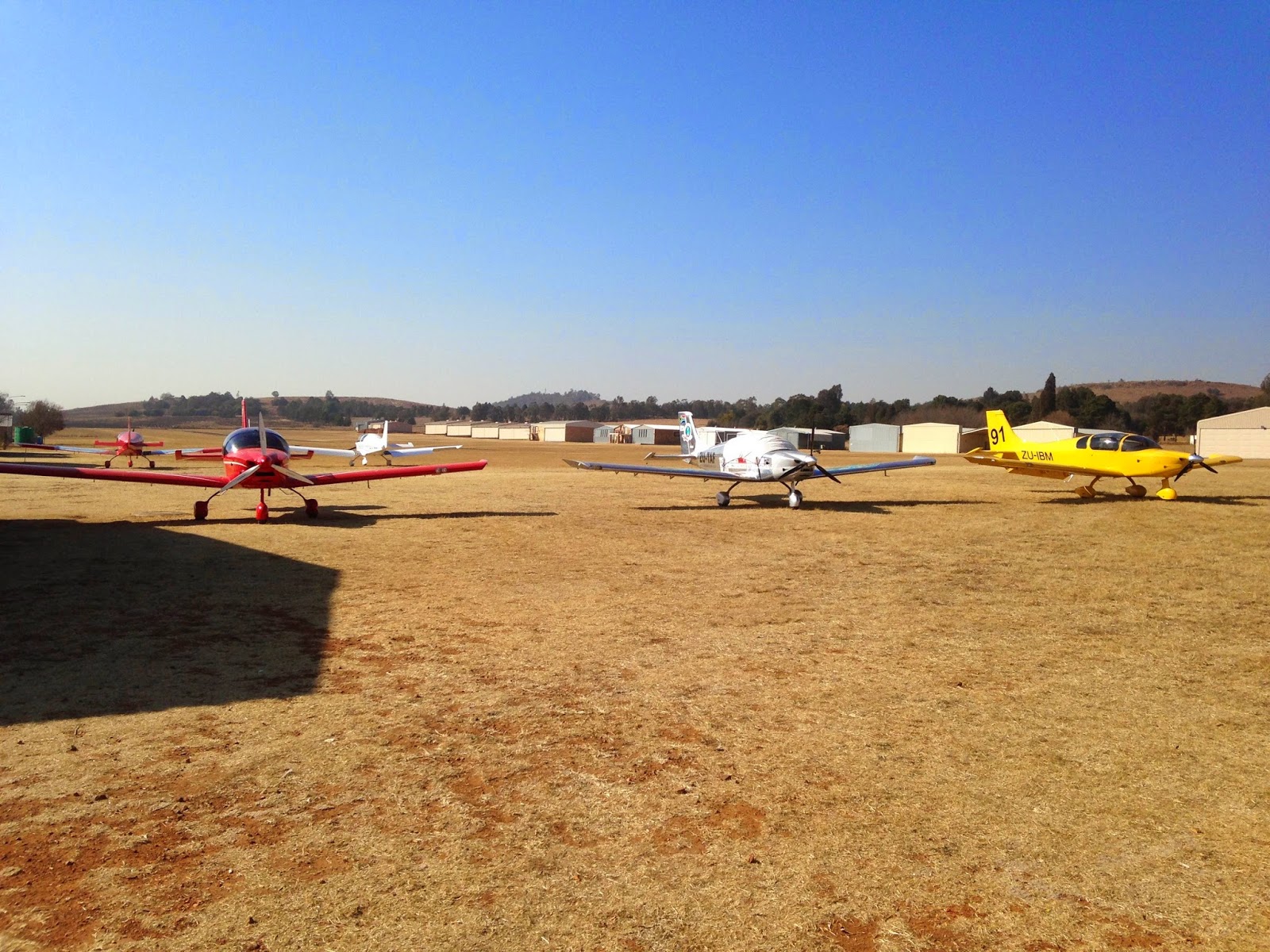
Here is Ian with the Explorer taildragger and then a few happy snaps as we took advantage of the clear Durban skyye after the rain and he showed me how to land the little bugger.

Ian poses before showing me how the plane works.. just taxiing the plane was taxing!

I think I can do this thing!!

Smart MGL glass cockpit of the Explorer with all the information you need to fly

Beautiful Durban and the harbour on take-off from Virginia Airport

Thursday, August 21, 2014

National Flight Instructor

I passed my flight test today for my National Flight Instructor Rating Grade C, so I will now be able to train my own students.. very chuffed and looking forward to this next phase of my aviation life. Thanks to my Instructor and flight school partner Brad for the hours he spent with me having as much fun as I was in my plane teaching me some of the more advanced techniques the Sling is capable of. Thanks also to Johnny our airline pilot who handled the flight test. Looking forward to working more with you. I am the first student of Durban Skyye Flight School to commence and complete training at the fledgling flight school.. many more to follow!! 

Johnny (right) with Dave during the flight test

It's a thumbs-up from Dave enjoying his flight test

About to go 

The view of the beachfront homeward bound on a poor weather day finishing off the flight test

Johnny completes the skills test assessment for submission to Raasa

Monday, August 18, 2014

Survival and emergency Equipment for our flight over the sea


In preparation for our  4 and a half hour flight over the sea next year from Mozambique to Madagascar, and in preparation for my Commercial Pilot Airlaw exam this week, here is the researched information on our Civil Aviation Regulations and Technical Standards (CARS and CATS) which apply to flights over the sea which exceed 30 mins or more than 50 nautical miles..

91.04.24 Life jackets and other flotation devices

No owner or operator of an aeroplane, shall operate the aeroplane –

(i) when flying over water and beyond gliding distance of land in the case of the aeroplane not capable of continuing the flight to an aerodrome with the critical power-unit becoming inoperative at any point along the route or any planned diversion;

(ii) when taking off or landing at an aerodrome where the take-off or approach path is so disposed over water that in the event of an incident, there would be a likelihood of a ditching, unless such aeroplane is equipped with a flotation device or a life jacket containing a survivor locator light, for each person on board, stowed in a position easily accessible, with safety belt fastened, from the seat or berth of the person for whose use it is provided, and an individual infant flotation device, containing a locator survival light for use by each infant on board.

91.04.25 Life Rafts and Survival Radio equipment for extended over-water flights

(1) An owner or operator must ensure that the aircraft is equipped with sufficient life rafts to carry all persons on board. Unless excess rafts or enough capacity are provided, the buoyancy and seating capacity beyond the rated capacity of the rafts must accommodate all occupants of the aircraft in the event of a loss of one raft of the largest rated capacity.

(2) The life rafts must be equipped with –
(a) a survivor locator light; and
(b) life saving equipment including means of sustaining life as appropriate to the flight to be undertaken.

(3) The following shall be included in each life-raft –
(a) a means for maintaining buoyancy;
(b) a sea anchor;
(c) life-lines and means of attaching one life-raft to another;
(d) paddles for life-rafts with a capacity of 6 or less;
(e) means of protecting the occupants from the elements;
(f) a water resistant torch;
(g) signalling equipment to make distress signals;
(h) for each 4, or fraction of 4 persons which the life-raft is designed to carry –
(i) 100 g glucose tablets;
(ii) 500 ml of water. This water may be provided in durable containers or by means of making seawater drinkable or a combination of both; and
(i) first aid equipment.
Note – Items (g) – (i), inclusive, should be contained in a pack.

(4) An aircraft must be equipped with at least two sets of survival radio equipment capable of transmitting on 121.5 MHz and 243 MHz.

(5) Unless the life rafts and survival radio equipment are clearly visible, their location must be indicated by a placard or sign, and appropriate symbols may be used to supplement the placard or sign.

91.04.23 Minimum number of ELTs to be carried


(1) Aeroplanes to be operated on extended flights over water or over areas where search and rescue would be especially difficult, shall carry at least one automatic ELT (emergency locator transmitter);

Emergency locator transmitters (ELTs), required to be fitted in terms of CAR 91.04.23, shall be capable of transmitting on the frequencies 121,5 MHz and 406 MHz simultaneously.

ps with aircraft weight being a consideration, I would swop sea anchor for more water!

Sunday, August 17, 2014

Last day of Instructor's training

I did my last training flight with our Flight School A Grade Instructor and CFI Brad today in preparation for my Instructor's Rating Skills test during the week. It is going to be a bit of a crazy week as I have registered for two Commercial Pilot exams on Wednesday and Thursday and hope to do my Instructor's Flight Test on Friday. Today we had a bit of fun in the skyye, avoiding some clouds and practising some simulated emergency landing on some ploughed sugarcane fields and the beach. We also did turning stalls and some advanced manoeuvres, getting really comfortable with the aeroplane n various unusual attitudes.

In the skyye and taking a selfie on the last training flight of my Instructor's rating with Brad
Taking off from Virginia for our adventure in the skyye. Isn't is great to have aviation aficionados to capture these special moments on camera!! Thanks Brian.

Banking away to the left cutting our own path through the skyye away from the clouds

The coastline around Amanzimtoti seen from the Virginia General Flying area

I also had a chance to jump on the back of Brad's microlight just to help him put the plane away in the hangar. With gusting winds someone needs to hold the wing (which moves in the wind) whilst the other handles the hangar doors.

Saturday, August 16, 2014

Flight School Manuals

Many months of my "spare" time were spent burning the midnight oil compiling the training manuals for our flight school which were approved in April. I have just completed a first revision and added the set of Practical Training Modules with the help of our Instructor Ian so that we have the theoretical and practical training syllabuses covered. These are for Part 62 (National Pilot Licence) training and I have also completed and submitted a full set for Part 61 (Private Pilot Licence) training as well to the CAA for approval.

I believe the learning process is enhanced if the students know where they are in the process, what needs to be achieved and what is expected of them. Ground instruction covering the full theoretical knowledge syllabus is also available, as well as the General and Restricted Radio Certificate. We are also registered as an online exam centre for the NPL exams.


Sunday, August 10, 2014

Completing Instructor's

I'm in the last throws of completing my NPL Instructor's course and today we spent 2 hours in the air north of Durban around the Tugela River mouth and Isithebe. We practiced a few simulated forced landings on the beach - the pics look like we were walking on the beach but the photo was taken a few seconds from a possible landing on the beach, then gave the engine full power and took off before a touch-down on the sand. We practiced this from several angles to ensure that I was comfortable making an emergency landing from any approach and would be able to successfully train a student to do the same.

We completed today's training doing similar "glide approaches" simulating engine failures around Isithebe airfield at random times.. closing my eyes whilst Brad manouvered the plane and then cut the power, then opened them to bring the plane down to a safe landing.

This could be a good landing. The wind was pumping up to 30 kts which means we could get the ground speed down to 30 kts before being in danger of connecting with the beach sand.

Brad (right) and I in the sky over Isithebe

Tugela River mouth and lighthouse up the north coast from Durban.

Brad has cut the power and we are floating down aiming for the stretch of sand on the other side of the river as it breaches the coastline

The glide takes us down close to the Lighthouse


Isithebe runway - an asphalt runway inland of the Tugela River mouth and suitable for practising emergency landings

On the way home past the Umhlanga Lighthouse

Coming in to land back at Virginia we tried an "Initial" - an approach towards and over the runway, taking a steep left turn and over to the beach then returning to land.

Wednesday, August 6, 2014

Visiting Tedderfield, home of The Airplane Factory

My trip to The Airplane Factory in pics. Wow, the factory in Johannesburg is pumping with over 200 airplanes flying or in production and more on order. My planes 400 hour service was like the pitt-stop at a Grand Prix with parts and covers coming off, the leather seats being treated, fine-tuning and spark splugs being changed and a huge checklist of regulatory maintenance checks being done.

Mainenance guys Dan and Nic with Airplane Factory Director Jean giving ZDL its checks.

Me en route to Johannesburg, home of The Airplane Factory

Passing by the mountains half-way

My daughter is teaching English in South Korea and this is what her kids came up with

Nic at The Aiplane Factory working on ZDL

New Slings in production at The Aiplane Factory

One of the reasons I love my Slings - designed and made in South Africa by a great team of incredible guys!

Dan working an an IS motor upgrade from Rotax

Not sure these lines are straight but he was giving it a bash

Not enough room in the hangars for all the planes, so there's a parking lot. I think I counted over 15 planes at the Factory

ZDLs tail inspection cover comes off to check the cabling and connector rods

This is what my prop hub looks like under the nose cone

ZDLs wheel nuts get checked and the tyres pumped - about the only rime it's possible to get to the valves to inflate them

Tea-break and the grease-monkeys sit on the wall

Dan checking my software and audio warning signals for the CAA inspection

Piet, the CAA Inspector makes the trip to Tedderfield to look over my plane for its addition to the flight school register as a training plane

Stefan, another of the factory's handsome guys who are working in the aviation industry

The Airplane Factory Director, Jean, is hands-on and brilliant when it comes to trouble-shooting.. making an adjustment to my seat catch mechanism.

The flight home showed how brown the winter grass is looking. Due to a gathering storm and winds I had to divert and re-route my jounrey home via Newcastle, Eshowe and the coast back to Virginia

The haze nearer the coast was bad and several airports were declared IMC - instrument meteorological conditions and not suitable for landing due to the poor visibility

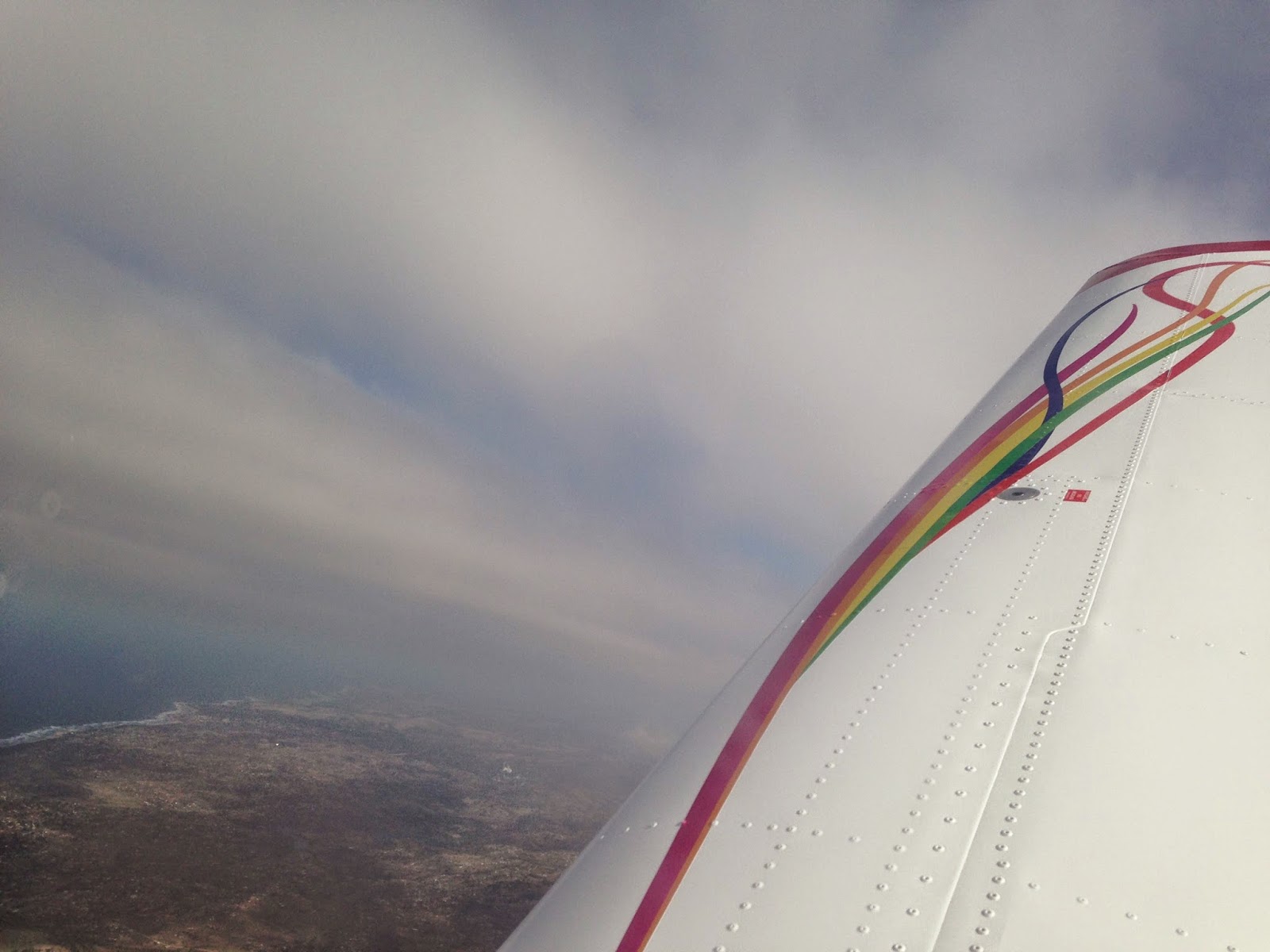
I cam across patches of cloud which I had to circumnavigate to get through to the coast

Darkness fell and after the 3 hour flight I had to dim the computer EFIS screens which became too bright and landed in the dark after 6pm, mission accomplished.

Tuesday, August 5, 2014

Tracking my flight back from Johannesburg


Was quite a day today with the CAA arriving to inspect my plane in Johannesburg for training purposes and then getting back to Durban with the south-wester that was brewing a storm, the weather changing en route. I had to divert from my routing to Ladysmith and Pietermaritburg to route instead to Eshowe then getting to the coast around Tugela and come down the coast to Virginia. The clouds were rolling in and by the time I got to the coast the clouds were down to 500ft, so if you have a look at the tracking of my plane you will see I actually overshot the coast and had to head back in from the sea to reach the coastline.
 
I flew up yesterday so that the plane's 400 hour service and annual inspection could be completed in time for the CAA inspection and for me to get home before it got too dark. As it was, I only got to leave Johannesburg at 3pm and landed in the dark at 6pm. Richards Bay had already been declared IMC but I requested a 500 ft routing in on a cross-country flight and the visibility improved along the coast as I transited through King Shaka airspace to Virginia. I will load more pics tomorrow.

Saturday, August 2, 2014

Upgrading the sound


After our power failure in the plane last year, I believed it was time to upgrade our headsets to the latest LightSpeed Zulu PFX headsets with bluetooth connectivity. This allows you to connect and operate your cell phone independently of the aircraft’s radio and power systems and hear yourself think above the noise of the engine. The headsets which arrived yesterday on order from the States are the company's newest generation headsets to hit the market. They are equipped with advanced noise cancelling technology that can also map the auditory landscape within the ear cap to assess and use the information to fine tune noise cancellation and audio responses.

With the free FlightLink app on my iPhone or iPad I can also record the conversations between pilot and the Air Traffic Controller and play them back or store them in my iTunes library for later retrieval. One can enable the Voice Clarity function which improves the quality of incoming calls from ATC by boosting frequencies common in human speech while reducing those that are not. Yay! for technological advances. I am looking forward to using them on my flight to Johannesburg on Monday to take ZDL up for its 400 hour service and annual inspection.